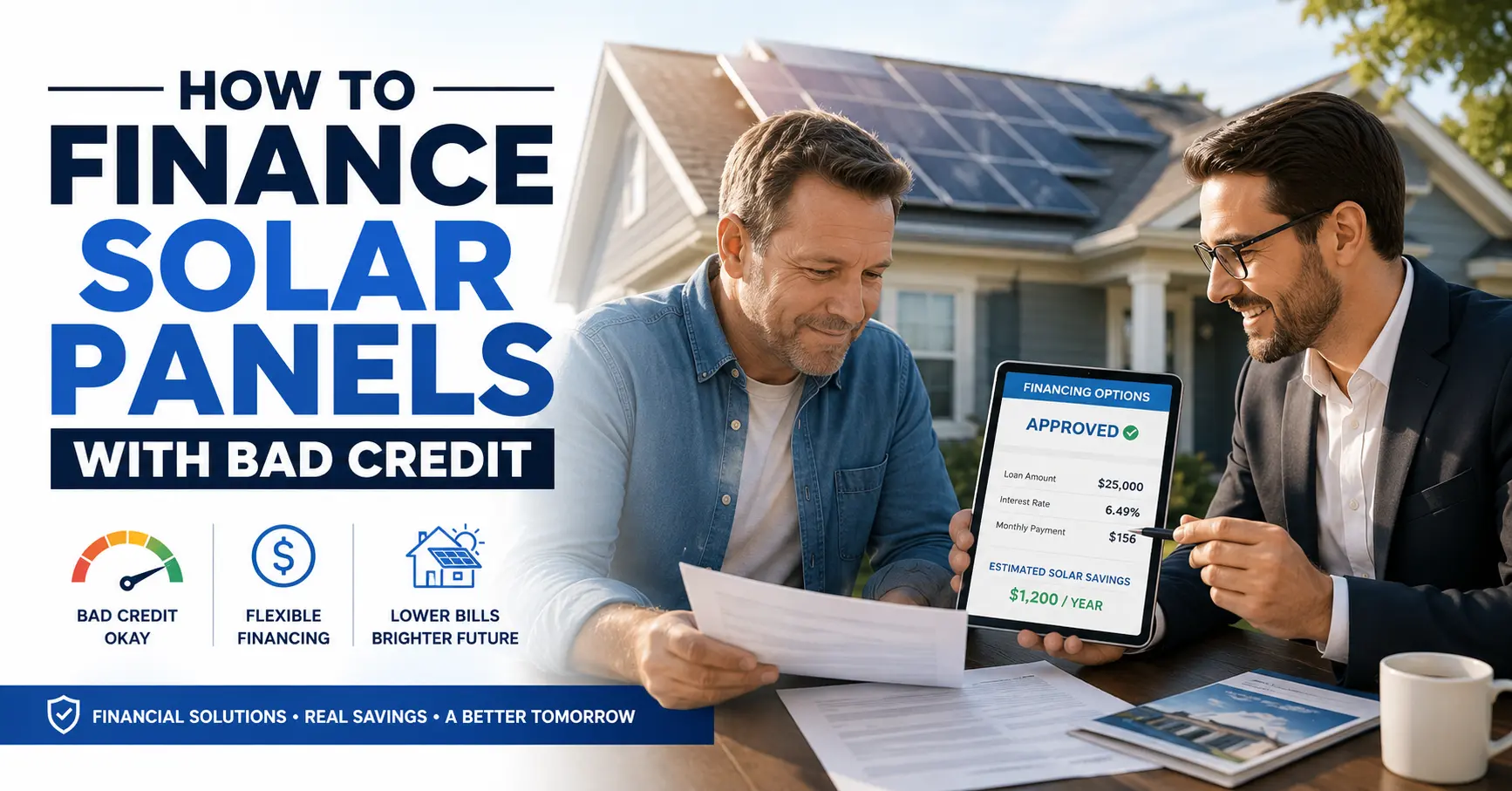
If you’ve looked into installing solar panels recently, you’ve probably experienced a bit of sticker shock. While solar energy can save thousands of dollars over time, the upfront cost often ranges from $15,000 to $30,000 for an average U.S. home.
For homeowners with excellent credit, financing solar panels is usually straightforward. But what if your credit score isn’t ideal?
The good news is that bad credit doesn’t automatically disqualify you from going solar.
In fact, many Americans with credit scores below 650 successfully finance solar installations every year through specialized lenders, solar leases, government-backed programs, and creative financing solutions.
Whether you’re recovering from past financial challenges, carrying credit card debt, or simply have a limited credit history, this guide will walk you through the best ways to finance solar panels with bad credit in 2026.
Why More Homeowners Are Choosing Solar in 2026
Electricity prices continue to rise across the United States. According to recent energy trends, many homeowners are paying significantly more for electricity than they did just a few years ago.
Solar panels offer several advantages:
- Lower monthly utility bills.
- Protection against rising energy costs.
- Increased home value.
- Access to federal tax incentives.
- Reduced carbon footprint.
- Greater energy independence.
For many families, solar isn’t just an environmental decision—it’s a financial one.
Consider a homeowner in Arizona paying $280 per month for electricity during the summer. If a solar system reduces that bill to $60, the long-term savings can easily add up to tens of thousands of dollars over the lifespan of the system.
That’s why financing has become such an important part of the solar industry.
Can You Get Solar Financing With Bad Credit?
Yes.
Many lenders consider factors beyond your credit score, including:
- Income stability.
- Employment history.
- Existing debt obligations.
- Homeownership status.
- Payment history on utilities and rent.
- Debt-to-income ratio.
While homeowners with excellent credit typically receive lower interest rates, borrowers with lower scores still have multiple financing options.
Generally speaking:
- 750+ Credit Score: Excellent financing options.
- 700–749: Very good financing terms.
- 650–699: Good approval chances.
- 600–649: Limited but available options.
- Below 600: Alternative financing may be necessary.
If your score is below 650, don’t assume you’ve run out of options.
Option 1: Solar Loans for Bad Credit
Solar loans remain one of the most popular financing methods in America.
Unlike traditional personal loans, solar loans are specifically designed for renewable energy projects.
Some lenders specialize in working with borrowers who have less-than-perfect credit.
Benefits of solar loans include:
- No large upfront payment.
- Ownership of the solar system.
- Eligibility for federal tax credits.
- Potential increase in home value.
However, borrowers with lower credit scores should expect:
- Higher interest rates.
- Larger down payment requirements.
- Shorter loan terms.
- Additional documentation requests.
Before applying, compare offers from multiple lenders. Even a difference of 2% in interest rates could save thousands over the life of the loan.
Tips for Improving Approval Odds
Before submitting your application:
- Pay down existing credit card balances.
- Avoid opening new credit accounts.
- Check your credit report for errors.
- Reduce your debt-to-income ratio.
- Provide proof of stable income.
Small improvements can make a significant difference.
Option 2: Solar Leases
If obtaining a loan seems difficult, a solar lease may be an attractive alternative.
With a lease, the solar company owns the equipment while you pay a fixed monthly fee to use it.
This option is particularly appealing for homeowners with lower credit scores because approval requirements are often less strict.
Advantages include:
- Little or no upfront cost.
- Predictable monthly payments.
- Maintenance usually included.
- Faster approval process.
The downside?
You won’t own the system, and therefore won’t qualify for the federal solar tax credit.
Still, for many homeowners, a lease provides an affordable path to solar without dealing with traditional financing hurdles.
Option 3: Power Purchase Agreements (PPAs)
Power Purchase Agreements have become increasingly popular in states like California, Florida, and Texas.
Instead of paying for the panels themselves, homeowners agree to purchase electricity generated by the system.
Here’s how it works:
- A solar company installs panels on your roof.
- The company owns and maintains the equipment.
- You pay for the electricity generated.
Many PPAs offer rates lower than utility companies.
For homeowners with bad credit, this can be an excellent entry point into solar energy because approval standards may be more flexible than traditional loans.
Option 4: PACE Financing
Property Assessed Clean Energy (PACE) financing deserves serious consideration.
PACE programs allow homeowners to finance energy improvements through their property taxes.
Key benefits include:
- Easier qualification requirements.
- Long repayment periods.
- No traditional loan structure.
- Potential approval despite lower credit scores.
However, availability varies by state.
PACE programs are commonly found in:
- California
- Florida
- Missouri
- Ohio
- Colorado
Before enrolling, make sure you understand how PACE obligations transfer if you decide to sell your home.
Option 5: Home Equity Financing
If you’ve built equity in your home, you may qualify for:
- Home Equity Loans.
- Home Equity Lines of Credit (HELOCs).
These options often offer lower interest rates compared to unsecured loans.
For example, a homeowner with:
- Credit Score: 620
- Home Equity: $150,000
may still qualify for favorable financing because the loan is backed by the property’s value.
Of course, there is a tradeoff: your home serves as collateral.
If you fail to make payments, your property could be at risk.
Federal Tax Credits Can Reduce Costs
One of the biggest advantages of going solar is the Federal Solar Investment Tax Credit.
As of 2026, eligible homeowners may qualify for significant tax savings on installation costs.
Let’s look at an example:
- Solar System Cost: $24,000
- Federal Tax Credit: 30%
- Potential Tax Savings: $7,200
That effectively reduces the net cost to $16,800.
Many homeowners overlook this benefit when evaluating affordability.
Even if your financing terms aren’t perfect, tax incentives can dramatically improve the economics of going solar.
States With Strong Solar Incentives
Certain states make solar particularly attractive.
California
- Net metering programs.
- State incentives.
- Strong solar adoption.
Texas
- High energy consumption.
- Competitive solar market.
- Property tax exemptions.
Florida
- Excellent year-round sunlight.
- Sales tax exemptions.
- Growing installer network.
Arizona
- Exceptional solar production.
- Lower long-term electricity costs.
New York
- State tax incentives.
- Strong renewable energy programs.
Homeowners in these states often see faster returns on their investment.
Common Mistakes to Avoid
Many homeowners make avoidable mistakes during the financing process.
Applying With Only One Lender
Always compare multiple offers.
Ignoring Hidden Fees
Ask about:
- Origination fees.
- Dealer fees.
- Closing costs.
- Early payoff penalties.
Choosing the Lowest Monthly Payment
Lower monthly payments often mean longer loan terms and higher total costs.
Skipping Credit Report Reviews
Errors on credit reports are more common than many people realize.
Review your report before applying.
Falling for High-Pressure Sales Tactics
If a salesperson says:
“This offer expires today.”
That’s usually a reason to slow down, not speed up.
Take your time and compare your options.
How to Improve Your Credit Before Applying
If your solar installation isn’t urgent, spending a few months improving your credit score could save substantial money.
Focus on:
- Paying bills on time.
- Reducing credit utilization below 30%.
- Paying off small debts.
- Avoiding late payments.
- Keeping older accounts open.
A credit score improvement from 620 to 680 could result in significantly lower interest rates.
Patience can pay off.
Is Solar Worth It If You Have Bad Credit?
For many homeowners, the answer is yes.
Let’s consider a simple example:
- Monthly Electric Bill: $250
- Estimated Solar Payment: $180
- Monthly Savings: $70
- Annual Savings: $840
Over 20 years, that’s more than $16,000 in savings—before accounting for rising electricity prices.
While financing terms may not be ideal initially, the long-term financial benefits can still make solar a smart investment.
The key is finding the financing option that aligns with your circumstances.
Frequently Asked Questions
What credit score is needed for solar financing?
Many lenders prefer scores above 650, but some programs accept borrowers with scores below 600.
Can I get solar panels with a 550 credit score?
Yes, although your options may be limited to leases, PPAs, or specialized lenders.
Do solar companies check credit?
Most financing providers perform a credit check, but requirements vary depending on the financing type.
Is a solar lease better than a loan?
It depends on your goals. Loans allow ownership and tax benefits, while leases typically offer easier approval.
Can solar panels increase my home’s value?
Yes. Studies have shown that solar-equipped homes often sell for more than comparable properties without solar systems.
Final Thoughts
Having bad credit doesn’t mean giving up on solar energy.
Today’s market offers more financing solutions than ever before, from solar loans and leases to PPAs and PACE programs. The best option depends on your financial situation, long-term goals, and how quickly you want to make the switch.
Remember, solar is a long-term investment. Even if your financing terms aren’t perfect today, the savings on electricity, potential tax incentives, and increased property value can make the decision worthwhile.
The most important step is simply getting started.
Request quotes from multiple providers, compare financing options carefully, and don’t let your credit score stop you from exploring one of the fastest-growing home investments in America.