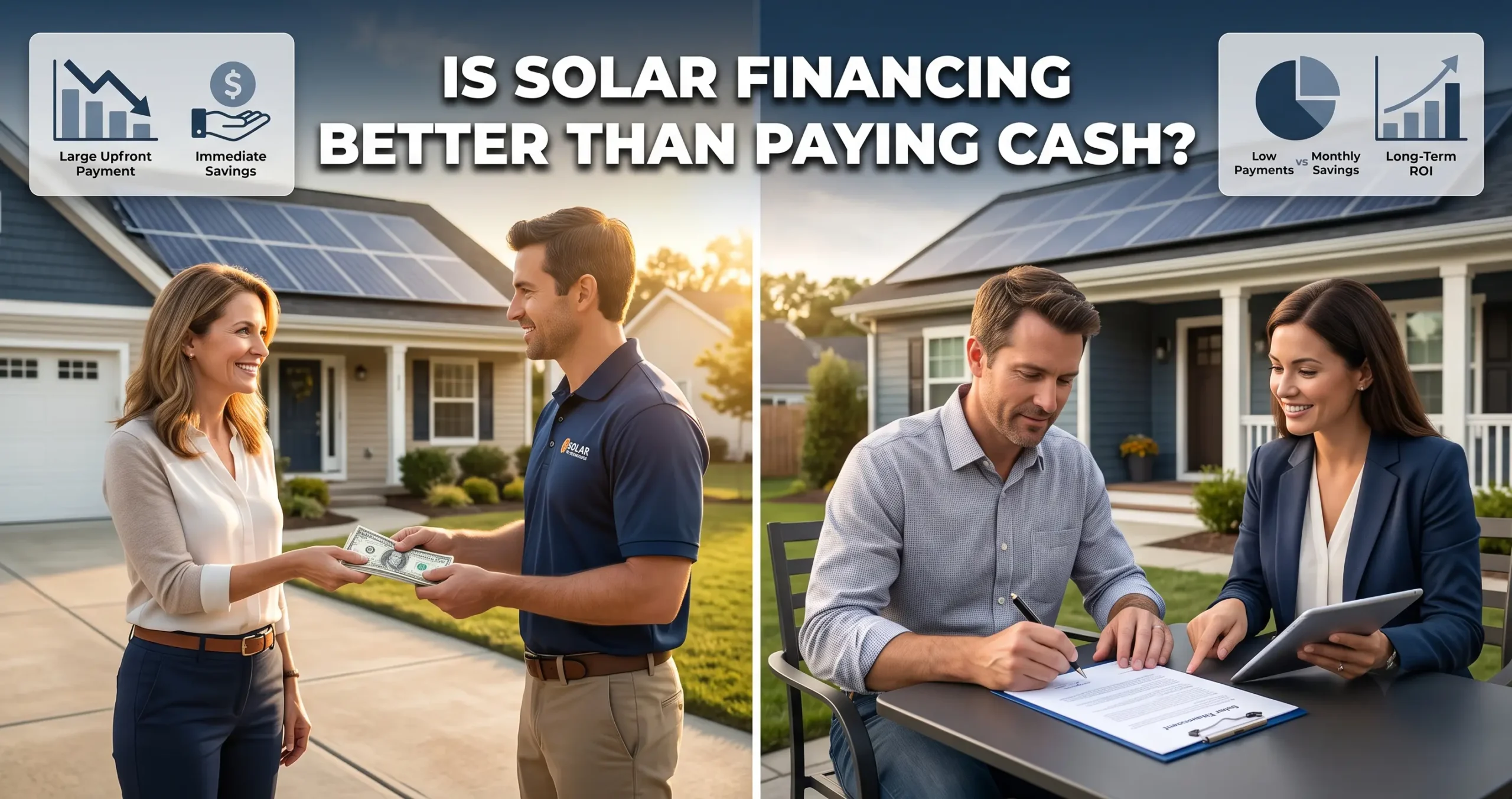
For many Americans considering solar panels, one question comes up almost immediately: Should you pay cash or finance your solar installation?
At first glance, paying cash seems like the obvious choice. After all, avoiding interest payments and owning your system outright sounds like a financial win. However, the answer isn’t always that simple.
In 2026, solar financing has become more accessible than ever. Homeowners can choose from solar loans, home equity financing, leases, and Power Purchase Agreements (PPAs), making solar energy attainable without a large upfront investment.
The reality is that the “best” option depends on your financial situation, investment goals, and how you prefer to manage your money.
Let’s take a closer look at the advantages and disadvantages of both approaches to help you determine which option makes the most sense for your household.
Why This Decision Matters
Installing solar panels is one of the biggest home improvement investments many homeowners will make.
The average residential solar system in the United States costs between $18,000 and $30,000 before incentives. While federal tax credits can significantly reduce that amount, it’s still a substantial expense.
Your decision affects:
- Monthly cash flow.
- Long-term savings.
- Return on investment.
- Eligibility for incentives.
- Financial flexibility.
- Home resale value.
Making the right choice can save thousands of dollars over the life of your solar system.
Paying Cash for Solar Panels
Paying cash means purchasing your solar system outright without taking on debt.
Once the installation is complete, you own the equipment immediately and are responsible for any future maintenance not covered by warranties.
Benefits of Paying Cash
Maximum Long-Term Savings
The biggest advantage is simple: no interest payments.
If a solar system costs $25,000 and you finance it over 15 years, you may end up paying several thousand dollars in interest. Paying cash eliminates that expense entirely.
Immediate Ownership
Cash buyers own their systems from day one.
This means:
- No lender involvement.
- No monthly payments.
- Full control over upgrades or modifications.
- Easier home resale in many cases.
Better Return on Investment
Many financial experts consider solar an investment.
For example:
- Solar Cost: $24,000
- Federal Tax Credit: $7,200
- Net Cost: $16,800
- Estimated Lifetime Savings: $40,000+
Without financing costs, your overall return tends to be higher.
Peace of Mind
Many homeowners simply prefer being debt-free.
Knowing your electricity bills have dropped without adding another monthly payment can provide considerable peace of mind.
Drawbacks of Paying Cash
Despite its advantages, paying cash isn’t always ideal.
Large Upfront Expense
Not everyone has $20,000 to $30,000 readily available.
Using your savings for solar could leave less money for:
- Emergency expenses.
- Retirement contributions.
- College savings.
- Home repairs.
Opportunity Cost
Suppose you have $25,000 available.
Would that money generate a better return elsewhere?
Some homeowners prefer investing in:
- The stock market.
- Real estate.
- Business opportunities.
- Retirement accounts.
If your investments consistently outperform your solar savings, financing may actually make more financial sense.
Financing Solar Panels
Solar financing allows homeowners to spread the cost over several years.
Common financing options include:
- Solar loans.
- Home equity loans.
- HELOCs.
- PACE financing.
- Personal loans.
Monthly payments can vary depending on:
- Loan amount.
- Interest rate.
- Credit score.
- Loan term.
Benefits of Financing
Preserve Your Cash
One of the biggest advantages of financing is maintaining liquidity.
Instead of spending $25,000 upfront, you can keep your money available for other priorities.
This flexibility is particularly valuable during uncertain economic periods.
Go Solar Sooner
Many homeowners wait years to save enough cash for solar.
Financing allows them to start reducing electricity costs immediately.
Imagine:
- Monthly Utility Bill: $240
- Monthly Solar Payment: $180
Even while making loan payments, you’re still reducing your monthly energy expenses.
Potential Tax Benefits
Homeowners who finance and own their systems are typically still eligible for federal tax credits.
This can help offset the initial cost and improve overall affordability.
Inflation Advantage
Fixed loan payments become relatively less expensive over time.
Meanwhile, utility rates continue to rise.
Many homeowners appreciate locking in a predictable payment rather than dealing with increasing electricity bills year after year.
Drawbacks of Financing
Interest Costs
This is the most obvious downside.
A financed system may ultimately cost several thousand dollars more than paying cash.
For example:
- System Cost: $25,000
- Interest Paid: $6,000
- Total Cost: $31,000
Over time, interest adds up.
Qualification Requirements
Financing often requires:
- Credit checks.
- Proof of income.
- Debt-to-income evaluations.
Borrowers with lower credit scores may face:
- Higher interest rates.
- Larger down payments.
- Fewer lender options.
Additional Monthly Payment
While solar can reduce utility bills, financing introduces another recurring expense.
Some homeowners simply dislike carrying long-term debt.
Comparing Solar Financing and Paying Cash
Paying Cash Is Usually Better If:
- You have substantial savings.
- You dislike debt.
- You want maximum long-term savings.
- You plan to stay in your home for many years.
- You don’t anticipate needing the cash elsewhere.
Financing May Be Better If:
- You want to preserve savings.
- You can secure a low interest rate.
- You prefer maintaining liquidity.
- You expect investment returns to exceed financing costs.
- You don’t want to wait several years to install solar.
A Real-World Example
Let’s compare two homeowners.
Sarah Pays Cash
- Solar System Cost: $24,000
- Tax Credit: $7,200
- Net Cost: $16,800
- Lifetime Savings: $42,000
Michael Finances
- Solar System Cost: $24,000
- Loan Interest: $5,500
- Total Cost: $29,500
- Lifetime Savings: $36,500
Sarah saves more overall.
However, Michael kept $24,000 in his savings account and started reducing his electric bills immediately.
Both homeowners made reasonable financial decisions based on their circumstances.
What About Solar Loans With Low Interest Rates?
Not all financing options are expensive.
Some lenders offer promotional rates for qualified borrowers.
If you qualify for a low-interest solar loan, the difference between financing and paying cash becomes smaller.
In some cases, homeowners choose financing specifically because they believe their cash can earn a higher return elsewhere.
This strategy isn’t right for everyone, but it’s becoming increasingly common.
Consider Your Emergency Fund First
Financial advisors often recommend maintaining three to six months of living expenses before making large purchases.
Before paying cash for solar, ask yourself:
- Do I have an emergency fund?
- Am I carrying high-interest debt?
- Will this significantly reduce my savings?
- Could I need this money in the next few years?
Solar savings are valuable, but financial flexibility is important too.
Frequently Asked Questions
Is it cheaper to finance solar or pay cash?
Paying cash is generally cheaper because you avoid interest charges.
Can I still claim the federal tax credit if I finance?
Yes. Homeowners who finance and own their systems are typically eligible for the federal solar tax credit.
What credit score is needed for solar financing?
Many lenders prefer scores above 650, although requirements vary.
Does financing reduce solar savings?
Yes, because interest expenses increase the total cost of ownership.
Is paying cash always the best option?
Not necessarily. Financing can make sense if preserving cash is a higher priority.
Final Thoughts
So, is solar financing better than paying cash?
For homeowners focused purely on maximizing savings, paying cash is usually the winner. You’ll avoid interest, own the system immediately, and enjoy the highest possible return on investment.
However, financing remains an excellent option for homeowners who prefer keeping their cash available, taking advantage of low-interest loans, or starting their solar journey without waiting years to save enough money.
Ultimately, the best choice isn’t the same for everyone.
The right decision depends on your budget, financial goals, and comfort level with debt. Whether you pay cash or finance your system, going solar remains one of the most impactful investments many homeowners can make in 2026.